
Introduction
Digital marketing is changing faster than ever. The way people search, discover brands, consume content and make buying decisions is being reshaped by artificial intelligence, social platforms and changing consumer expectations.
For businesses, following the latest digital marketing trends is no longer simply about trying every new platform or technology. It is about understanding where customers are moving and adapting your marketing strategy accordingly.
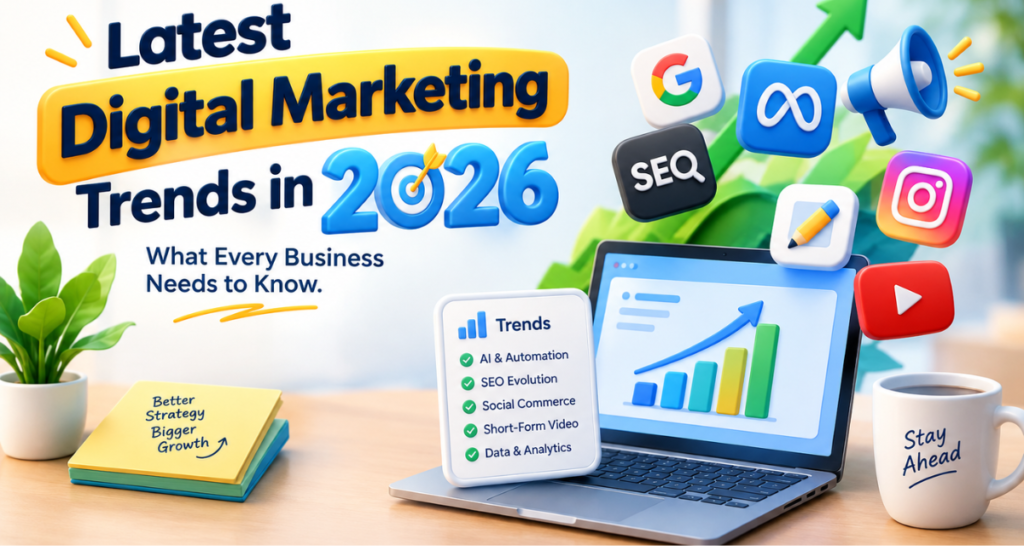
In 2026, AI-powered search, authentic content, short-form video, social discovery, personalization and first-party data are becoming increasingly important. Google also highlights AI-driven changes in consumer behaviour and the growing importance of richer, more useful brand experiences.
So, what should businesses actually pay attention to? Let’s explore the trends that could have the biggest impact in 2026.
Why Digital Marketing Trends Matter for Businesses in 2026
Customer behaviour is no longer limited to traditional search engines. People can discover a business through Google, social media, YouTube, AI assistants, online communities, marketplaces and messaging platforms.
Research on India also shows that online discovery is becoming more fragmented across search engines, AI assistants, maps, marketplaces and other platforms.
This means businesses need to think beyond individual marketing channels. The current digital marketing trends point toward a more connected approach where visibility, useful content, trust and customer experience work together.
The businesses that adapt early can create stronger connections with potential customers while avoiding the risk of relying on outdated marketing methods.
Latest Digital Marketing Trends Businesses Should Watch in 2026
1. AI Is Changing How Customers Search

One of the biggest latest digital marketing trends is the growth of AI-powered search.
People are increasingly using conversational AI tools to explore questions, compare options and discover information. Google has also identified AI as a major force reshaping consumer behaviour and search experiences in 2026.
For businesses, this means content needs to be more than keyword-focused. Websites should provide clear answers, demonstrate expertise, explain topics thoroughly and make important information easy for both people and search systems to understand.
This is where concepts such as Answer Engine Optimization and Generative Engine Optimization are becoming increasingly relevant.
2. Search Is Moving Beyond Traditional Search Results

Search is becoming more conversational and visual. Consumers can now combine text, images and other forms of information when researching a topic.
The implication is simple: businesses should build a strong information ecosystem rather than depend on a single keyword.
Useful articles, FAQs, product information, videos, reviews and authoritative brand content can all contribute to discoverability.
The current digital marketing trends suggest that search visibility increasingly depends on being useful wherever customers are looking for answers.
3. Short-Form Video Continues to Dominate Attention

Short-form video remains one of the most important areas to watch in the Social media marketing trends 2026 landscape.
Instagram Reels, YouTube Shorts and other short-form formats allow businesses to communicate ideas quickly. But simply posting frequently is not enough.
Successful short-form content should give viewers a reason to stop scrolling.
Businesses can experiment with:
- Educational videos
- Quick tips and tutorials
- Product demonstrations
- Customer stories
- Behind-the-scenes content
- Industry insights
- Frequently asked questions
The objective should be to create content that is useful, entertaining or genuinely interesting—not simply promotional.
4. Social Media Is Becoming a Search and Discovery Channel

Social platforms are increasingly being used for discovery, research and recommendations. HubSpot’s 2026 research identifies social search, short-form video, social commerce and creator marketing among the important shifts shaping social media.
This is an important development within the Social media marketing trends 2026 landscape.
Businesses should therefore think about whether their social profiles and content answer the questions potential customers are asking.
Instead of focusing only on follower numbers, consider:
Can someone discover your brand, understand what you offer and develop trust through your social content?
That is a much more valuable goal.
5. Authentic and Original Content Is Becoming More Valuable
Generative AI has made content creation faster, but it has also made generic content easier to produce.
As a result, original perspectives can become an important competitive advantage.
Businesses should create content based on:
- Real customer questions
- Industry experience
- Original insights
- Case studies
- Demonstrations
- Expert opinions
- Customer experiences
Google’s 2026 marketing guidance emphasizes the continuing importance of useful, authoritative content as AI changes how people explore information.
AI can help with productivity, but businesses should avoid publishing large volumes of generic content simply because it is easy to generate.
6. Personalization Is Becoming a Customer Expectation
Customers increasingly expect businesses to understand their interests and provide relevant experiences.
Personalization can include tailored website experiences, relevant recommendations, segmented communication and content designed for specific customer needs.
However, personalization should provide genuine value. Businesses should avoid using customer data in ways that feel intrusive.
The latest digital marketing trends show a movement toward smarter customer journeys rather than one-size-fits-all communication.
7. Creator Marketing Is Moving Toward Authenticity
Influencer marketing is evolving. Having a large follower count does not automatically mean a creator is the best choice for a brand.
Niche creators and micro-influencers can offer something particularly valuable: relevance and audience trust.
Gartner’s 2026 marketing predictions also point toward greater emphasis on creator authenticity as AI-generated media becomes more widespread.
For businesses, the key question should therefore be:
Does this creator have credibility with the audience I want to reach?
The answer may be more important than the number of followers.
8. First-Party Data Is Becoming More Important
Privacy and data ownership are becoming increasingly important considerations for marketers.
Businesses should focus on building direct relationships with customers through channels such as email databases, customer accounts, loyalty programmes, enquiry forms and other consent-based interactions.
First-party data can help businesses understand their customers while reducing dependence on external platforms.
This is one of the current digital marketing trends that businesses should consider as part of their long-term marketing strategy.
How Businesses Can Adapt to the Current Digital Marketing Trends
Following every trend is neither practical nor necessary. Instead, businesses should create a focused approach.
Start with these seven steps:
- Understand your audience – Identify what your customers search for, watch and discuss.
- Audit your online presence – Check your website, social profiles and content.
- Create useful content – Answer real customer questions instead of writing only promotional posts.
- Use AI responsibly – Use AI to improve productivity while keeping human expertise and review at the centre.
- Experiment with video – Test short, useful and authentic video formats.
- Build first-party relationships – Develop customer databases and communication channels responsibly.
- Measure business outcomes – Focus on meaningful metrics such as qualified enquiries, conversions, retention and customer engagement.
Which Digital Marketing Trends Should Your Business Prioritize?
Not every business needs to adopt every trend.
Small businesses can begin with useful local content, social proof, short-form videos and a strong online presence.
Growing businesses can focus on content systems, personalization, AI-assisted workflows, social discovery and customer data.
Established businesses may benefit from deeper AI integration, first-party data strategies, customer experience improvements and stronger brand authority.
The goal is not to follow trends simply because they are popular. The goal is to identify which changes actually matter to your customers and business model.
Conclusion
The latest digital marketing trends in 2026 point toward a more intelligent, personalized and customer-focused digital environment. AI is changing search, social platforms are becoming discovery engines, short-form video continues to capture attention, and authentic content is becoming increasingly valuable.
Businesses that succeed will not necessarily be those that adopt every new technology first. They will be the ones that understand their customers, create useful experiences and adapt when behaviour changes.
If you want to strengthen your business’s online presence, you can explore more about digital marketing and growth strategies at Banana Leaf Digital.
Frequently Asked Questions
What are the latest digital marketing trends in 2026?
The major trends include AI-powered search, conversational discovery, short-form video, social search, personalization, creator marketing, authentic content and first-party data. Businesses should select trends based on their audience and objectives rather than attempting to adopt everything.
What are the current digital marketing trends businesses should follow?
Businesses should pay attention to AI-driven search, useful original content, social discovery, video, personalization, creator partnerships and privacy-conscious data strategies. The right combination depends on the business’s audience, industry and customer journey.
What are the Social media marketing trends 2026 businesses should know?
mportant trends include short-form video, social search, creator-led content, community building and social commerce. Businesses should focus less on follower counts and more on creating content that helps customers discover, understand and trust their brand.
How is AI changing digital marketing in 2026?
AI is changing how consumers search for information and how businesses create, personalize and analyze marketing content. AI can improve efficiency, but human expertise, originality, accuracy and brand trust remain important.
How can small businesses adapt to digital marketing changes?
Small businesses should focus on understanding their audience, creating useful content, improving online visibility, experimenting with short-form video and building direct customer relationships. They do not need to adopt every new platform or technology to remain competitive.
T